


















The I.F. Stone Medal Project for Journalistic Independence
Read the remarks of these speakers regarding the medal on the occasion of the 100th birthday celebration
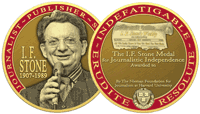
of I.F. Stone: Award WinnersOn March 5, 2008, The Nieman Foundation for Journalism at Harvard University announced plans to award an annual “I.F. Stone Medal for Journalistic Independence,” followed immediately thereafter by an “I.F. Stone Workshop on Strengthening Journalistic Independence.” The Nieman Foundation press release can be found here and at www.nieman.harvard.edu. The project in honor of I.F. Stone is, in reality, the beginning of a campaign to maintain, encourage and increase journalistic independence of journalists, journalistic institutions and journalism itself—all under special stress today for economic, technological and political reasons. On October 7, The first of these medals was presented to John Walcott, Washington Bureau Chief of the McClatchy Company for his exemplary leadership in directing his team of Knight Ridder reporters in their probing, incisive coverage of events during the run-up to the war in Iraq in 2002 and early 2003. At the conclusion of his address, a panel discussion was held to collect ideas for strengthening journalistic independence related to Walcott’s experience and speech. Tom Rosenstiel of the Project for Excellence in Journalism (PEJ) moderated the discussion. The panelists were Gilbert Cranberg, Florence Graves, Charles Lewis, Michael Massing and Jane Mayer. Approximately 125 persons attended the award ceremony and workshop which was held at the Newseum in Washington. Thanks to the Knight Foundation and the Carnegie Corporation for their sponsorship. I.F. Stone had an extraordinary capacity for independence at any personal cost. His opposition to Joseph McCarthy and his determination to expose the excesses of J. Edgar Hoover kept him a political pariah when America was cowed by McCarthyism. Although himself a Jew, his support for justice for the Palestinians estranged him from the American Jewish community. And when the National Press Club refused to serve a black judge whom I.F. Stone had brought to lunch, he resigned from the Club, thus isolating him from the main meeting place of his colleagues. But he never wavered. And his love of journalism kept him joyous. Obviously, not every journalist can publish his own newsletter and do it without advertising, as did I.F. Stone. But every journalist, and every journalistic publication, wants and need a maximum of independence, within its constraints, to do its job. This means insulating journalists from inappropriate commercial, personal, sectarian and other pressures. And it means insulating editors, publishers and owners from these kinds of pressures as well. Journalism itself plays a constitutional role in this country that deserves constant vigilance and cries out for independence. Accordingly, the objective of this annual award is to use I.F. Stone’s reputation for independence to strengthen the independence of journalism by providing this annual medal award and workshop as a point of annual reference, discussion and brainstorming. The Nieman Foundation has opened two accounts for contributions from those who wish to help fund these activities in a fashion adequate to the task. One fund will be available for large donations toward an endowment. Another fund is available toward ongoing operating expenses and shortfalls until such time as the endowment is large enough to provide the necessary income or to fund new projects related to journalistic independence. An anonymous donor has offered to match contributions toward the endowment fund up to a total of $100,000; thus each $1 contributed to this fund would produce, in effect, $2. These contributions are tax‑deductible and can be made, through pledges, over more than one taxable year. Persons wanting to contribute toward this project should visit the Neiman home page where they will be further directed. Donors will be asked to specify whether the money should go into the I.F. Stone Endowment Fund for Journalistic Independence or the I.F. Stone Operating Fund for Journalistic Independence.
|